

Pictured: Emma Mendoza, Xenia Esparza, and Manuel Ramirez
By: Dr. Andrew Yox, Honors Director
For over a decade, the students of the “BioTex” honors seminar at NTCC have experienced a November “email shootout.” This is something like a cross between an ongoing basketball game with scores changing in real time, and a fast-paced, scholarly-poetic thinkathon. The course challenges students to conceptualize the elements of their Texas history research essays, to utilize crossover “analogs, (terms)” particularly from biology and other scientific fields, and to provide terse definitions of newly minted concepts.
This year, Xenia Janeth Esparza bested all others, winning $50. She coined and defined an interrelated conceptual field for her research on the “Recidivism of the Texas Tick.” According to Esparza, scientists and cattlemen in Texas have for too long celebrated their victory over “Texas Fever” through the practice of cattle dipping in vats of arsenic. Actually, a second “Arachnid War” has begun, with the ticks showing a capacity for “vector shift,” striking out at domestic pets and humans with a new ferocity, and an unprecedented efficacy in projecting new diseases.
Manuel Ramirez came in second and won $30. His topic is related to the work of Esparza’s and concerns the “Rise of the Humanophobe Environment in Texas.” Ramirez charts the course of “mundane animals” in Texas who have declined, the “charismatic animals” of the state such as the bison and the ocelot that need subsidies, “domestic parasites” such as highly groomed and cared for, dogs and cats which have assumed more prestige in Texas in recent decades than human outcasts, such as the homeless, and finally the “Rise of the Pests”—the screwworms, mosquitos, ticks, fireants, wild hogs, and cockroaches that have thrived even amidst the urbanization of modern Texas.
Emma Mendoza, came in third, winning $20. Mendoza is dealing with the story of a “token heroine,” Jovita Idar, who was brandished as a female shield or “puppit” in the World War I era and made into a retroactive heroine by writers needing a Tejana spokesperson for the era of the early twentieth-century.
Amidst the individual competition, there was also a team element. This year’s winning conceptualization team of Andrew Higgins, Stephen Hixson, and Manuel Ramirez have also been the winners of a series of impersonation encounters with the three other groups of the class.
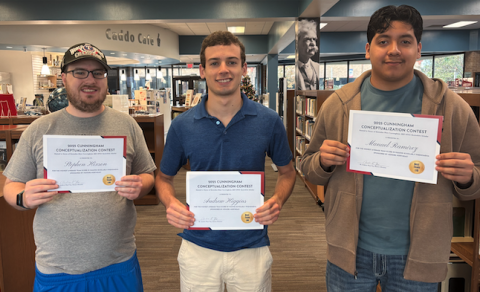
There was also this year, a single best concept prize given to Ian Mares. His term ‘dichotomodernism’ refers to ways in which smaller cities and towns of Texas have developed differently from the big metropolitan areas. Mares is focusing on a fascinating contrast between Northeast Texas with its semi-rural vibe, and the rapacious, centrifugal suburbanization of Dallas-Fort Worth.
Honors Director and Texas history professor Dr. Andrew Yox notes that “conceptualization is the key to writing an alluring, coherent essay, animated by a creative argument. It also is the key to writing conference-accepting abstracts. Our students do this well, and there are many more we could mention not only in the honors seminar, but in non-honors sections of history where a state-mandated goal is to form a “creative argument.” At the same time, I am very excited about the conceptualized projects Esparza, Ramirez, Mendoza, Mares, and others are developing.”

The Cunningham Conceptualization Awards receive their name from Emmalea (Shaw) Cunningham who as a Presidential Scholar at NTCC won a Guistwhite Award, and published the essay, “Blind to Brown,” the story of how Northeast Texas came to accept federal mandates to integrate their schools in the 1970s. It was also a highly conceptualized, award-winning article. Cunningham also became the first NTCC honors alumni to donate a significant amount to Honors Northeast. After receiving her doctorate, Emmalea is now a licensed therapist, married and a mother, living in Georgetown, Texas.
Of the individual winners, Esparza, Mendoza and Ramirez all reside in Mount Pleasant. Ian Mares, a 2025 graduate of Paul Pewitt High School, resides in Morris County.